
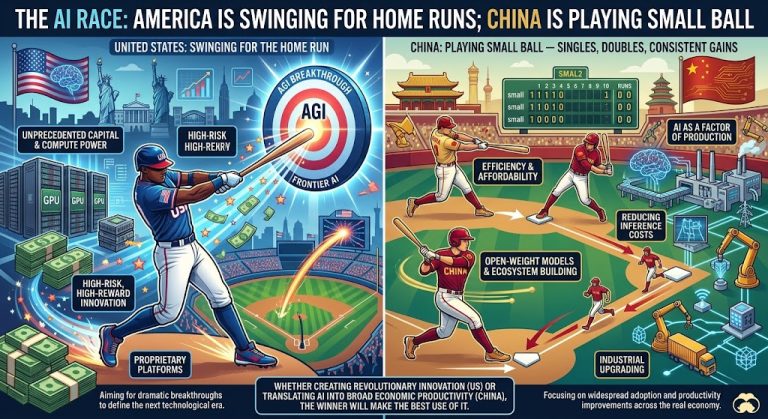
The AI Race: America Is Swinging for Home Runs; China Is Playing Small Ball
By Joel Wong
The baseball metaphor captures an important strategic difference in how the United States and China approach artificial intelligence. While both countries recognize AI as a transformative technology, they emphasize different paths to leadership.
The United States: Swinging for the Home Run
The American strategy centers on frontier innovation: developing increasingly powerful large language models (LLMs), pursuing Artificial General Intelligence (AGI), and pushing the boundaries of what machines can do.
This approach reflects America’s strengths in entrepreneurship, venture capital, advanced semiconductors, cloud computing, and world-class research.
Capital and computing power: Technology giants are investing hundreds of billions of dollars collectively in GPUs, data centers, and computing infrastructure to build increasingly powerful AI systems.
High-risk, high-reward innovation: The objective is to achieve major technological breakthroughs that could transform entire industries, establish new markets, and create enormous economic value.
Commercialization: Much of the business model relies on proprietary platforms, subscription services, API access, and ecosystem lock-in.
The American bet is that whoever reaches the next technological frontier first will secure a decisive competitive advantage.
China: Playing Small Ball—Singles, Doubles, and Consistent Gains
China’s approach is shaped partly by U.S. semiconductor export restrictions and constraints on access to the most advanced computing hardware. Rather than relying exclusively on ever-larger models and computing clusters, Chinese companies have placed considerable emphasis on efficiency, affordability, open-weight models, and practical applications.
Efficiency over brute force: Developments such as DeepSeek and Alibaba’s Qwen demonstrate that competitive AI capabilities can be achieved with more efficient architectures and lower costs. The objective is to narrow the performance gap while dramatically reducing the cost of training and deployment.
AI as a factor of production: China increasingly views AI as an enabling infrastructure for upgrading the physical economy—not simply as another software industry. Applications span manufacturing, smart grids, logistics, supply chains, autonomous systems, and industrial robotics.
Building a broad ecosystem: Affordable and accessible models encourage adoption by developers, businesses, and manufacturers. Wider deployment generates operational data and practical experience, creating a feedback loop between AI development and real-world applications.
The Chinese bet is that widespread adoption and cumulative productivity improvements can generate greater economic returns than technological breakthroughs alone.
The Strategic Trade-Offs
Dimension United States: Home Runs China: Singles and Doubles
Primary objective Frontier AI, AGI, technological leadership Widespread adoption and productivity
Main strengths Capital, advanced chips, research, computing infrastructure Manufacturing, cost efficiency, industrial integration
Business model Proprietary platforms and premium services Open-weight models and affordable deployment
Economic strategy Create new markets and technological breakthroughs Upgrade existing industries and production
Main vulnerability High capital requirements and uncertain returns from scaling Semiconductor constraints and potential frontier-performance gaps
The Bigger Picture
The metaphor should not be taken too literally. China has not abandoned the pursuit of frontier AI, just as America is not ignoring practical industrial applications. Both countries are pursuing multiple strategies, but their relative priorities and structural advantages differ.
The deeper distinction is between creating technological breakthroughs and translating technology into broad economic productivity.
America’s strategy assumes that leadership at the technological frontier will eventually produce overwhelming economic advantages. China’s strategy places greater emphasis on making AI affordable, accessible, and useful across the entire economy.
Ultimately, the AI race will not be decided by model benchmarks, investment totals, or the occasional spectacular breakthrough alone. It will also depend on which country can translate artificial intelligence into sustained improvements in productivity, industrial competitiveness, and living standards.
Hitting home runs makes headlines, but getting runners on base and bringing them home wins championships. The real question is not simply who builds the smartest AI, but who makes the best use of it.
