
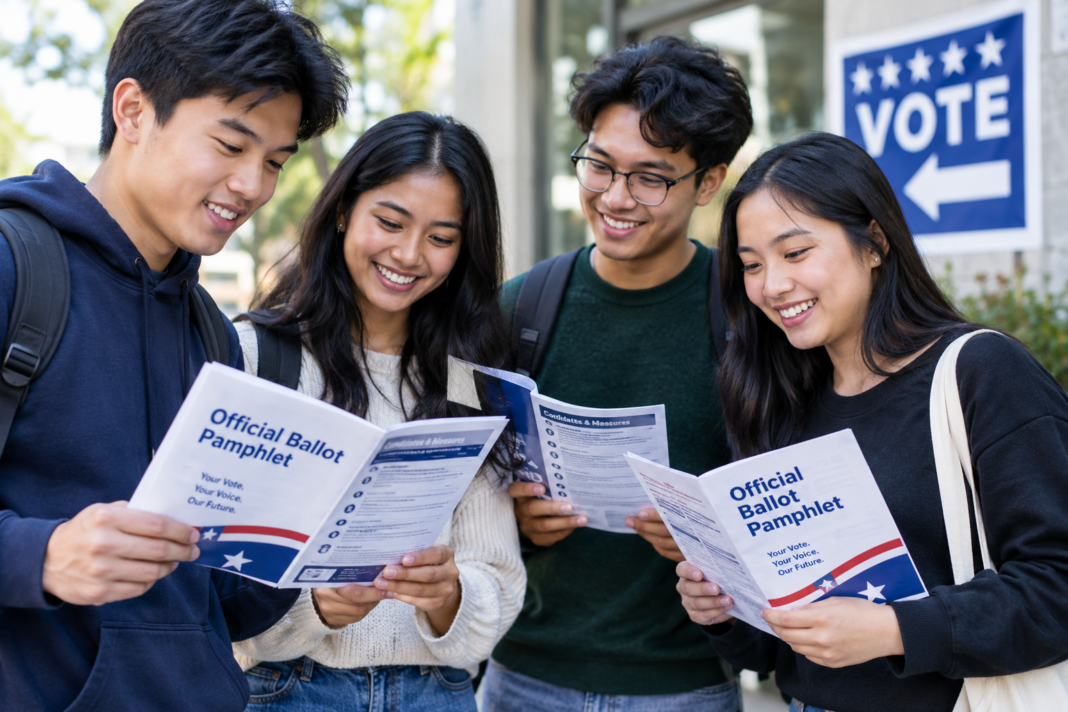
AAPI Voters Could Decide the Midterms, If They Make It to the Ballot Box
By Sunita Sohrabji for American Community Media
90% of AAPIs say they intend to vote in the Nov. 3 midterm election, and 64% say they absolutely will, according to a new report by AAPI Data.
Asian Americans and Pacific Islanders could be the margin of victory in key battleground races in the Nov. 3 midterms, if they manage to overcome obstacles to voting.
AAPIs are the nation’s fastest-growing voter bloc, and recent elections have demonstrated their potential to shape outcomes in highly competitive races across the country, noted a new survey released jointly by AAPI Data and APIA Vote. There are 16 million eligible AAPI voters in 2026, including 1.6 million newly eligible voters since 2022.
Asian Americans are the only major voting bloc where the vast majority is foreign-born, according to AAPI Data.
About 90% of registered AAPI voters who were surveyed said they plan to vote in the midterms, and 64% said they will absolutely vote, noted Karthick Ramakrishnan, founder and director of AAPI Data, at an Oct. 16 American Community Media news briefing.
“We will likely see another record-setting year if people are actually able to get to the ballot box and effectively cast their vote,” he said.
How will AAPIs vote in the midterms?
In House races, 52% of AAPIs surveyed said they plan to vote for a Democrat, while 32% said they will vote for the Republican candidate. Only 21% of AAPIs view President Donald Trump favorably. Incumbent Republicans also received low voter approval among AAPIs, according to the survey, with just 22% favorability. Incumbent Democrats received 47% favorability.
Kitchen table issues, such as the flailing economy and the cost of healthcare, are top concerns for AAPI voters. Ramakrishnan noted a surprising shift, however, in sentiment around immigration policy.
“Support for mass deportation has fallen a lot. What we saw in December 2024 — a kind of honeymoon period for the Trump administration — was that our community was split on mass deportations. Thirty-eight percent supported deporting all people living in the country illegally. By February of 2026, that plummeted to 29%.”
Support further eroded in the summer of 2025, after high-profile ICE arrests in Los Angeles, and the raid of a Hyundai-LG plant in Atlanta that September, at which more than 475 South Korean workers were arrested by ICE and taken into detention.
“We are also seeing very high opposition to immigration enforcement spending. Seventy-two percent say that enforcement spending is too high,” said Ramakrishnan.
Early voting
Mary Lou Akai Ferguson, executive director of the Asian American Power Network, pointed to Michigan, where early voting is already underway.
“As of yesterday, we saw in Michigan that 26,000 Asian Americans have already cast their early votes. That is thousands more than in 2022,” Ferguson said. “The average Senate margin of victory in Michigan is 55,000 votes, so we’re already closing in on Asian Americans casting many ballots that are going to exceed the margin of victory in these upcoming elections.”
She said the money needed to turn interest into votes is scarce. “The funding is much, much lower this year than in any past cycle we’ve seen, especially for midterms, coming in at about half of 2022 levels across the entire ecosystem for voter mobilization and voter turnout work.”
In Nevada, her network planned to hire Korean American and Chinese American organizers early this year but could not. “Now we are trying to figure out the pieces, using research and data, where really we know that community knowledge would have brought us a long way,” Ferguson said.
Barriers at the polls
Christine Chen, executive director of APIAVote, said the barriers reach beyond funding. She described a shift from an era when “voting rights was supported by both Republicans and Democrats” to one in which some states have narrowed ID options, restricted mail voting and drop boxes, and shortened early voting.
She cited Tarrant County, Texas, which cut 92 polling locations, to 224 from 316 in 2022. “That actually impacts one million registered voters, including over 75,000 API voters,” Chen said. “Now, those voting sites that were eliminated are in predominantly minority areas.”
Chen also warned that the Supreme Court’s decision to let the federal government keep using the Department of Homeland Security’s SAVE database to check voter rolls puts some voters at risk. She advised people to check their registrations, make a plan to vote, and know that they can request a provisional ballot if their name is missing. One phone call could be the difference between someone staying home and casting their ballot and having that correct information.”
Confusion is itself a barrier, she said. Some community leaders have told her they thought mail ballots would not be available, a sign of how widely that narrative has spread. “
Voter turnout is high among older AAPIs, but lackluster among millennials and Gen Z’s, noted Chen, flipping the misconception that immigrant adults tend not to vote.
Where do a few thousand votes matter?
Shekar Narasimhan, chairman and executive director of the AAPI Victory Fund, said his group is concentrating on places where AAPI votes could be decisive, including Alaska.
“There’s only 660,000 voters in the whole state of Alaska. Elections are decided typically by 10,000 votes,” he said. Fewer than 20,000 of the state’s 56,000 Asian American, Pacific Islander and Native Hawaiian voters are expected to vote, he said, noting that the challenge lies in convincing 10,000 of those remaining 36,000 to vote.
A significant challenge lies in engaging Millennials and Gen Zs. “Young people have every right to say the political establishment has failed me. They tend to move to the extremes. And when they see authenticity, when they see a Zohran Mamdani (Mayor of New York) they get excited. When they see an Abdul El-Sayed (Michigan candidate for the US Senate) they get excited. They say: ‘That’s authentic. That’s real. This son of a bitch will go fight for me. That’s what I want.’”
He warned against complacency. “Do not take our community for granted or any segment of it. It is changing, it is growing, it is getting younger. Our community, bottom line, is not going to accept being taken for granted.”
