
‘Keep Your Services’ Say Asian Community Leaders, Amid Fear of New Public Charge Rules
By Sunita Sohrabji for American Community Media
Image by Sunita Sohrabji
OAKLAND, Calif. — The new public charge rule does not apply to all immigrants, said Asian American community leaders, advising people to keep federal benefits for which they and their families are qualified to receive.
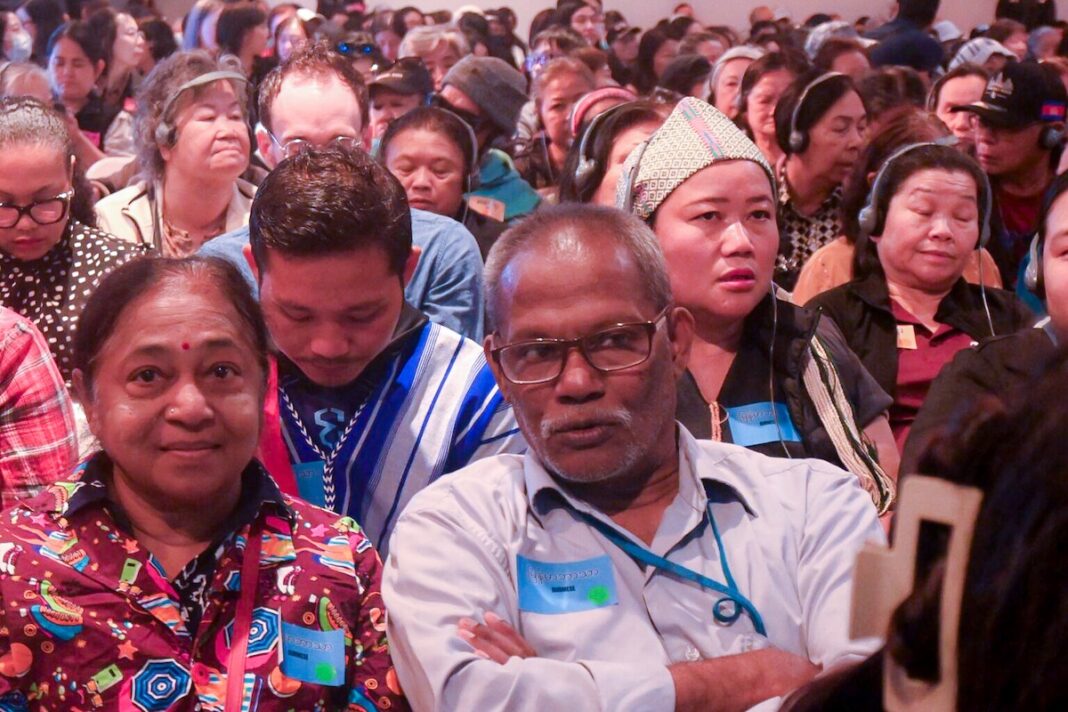
More than 900 Asian Americans packed a room here Sept. 30 to express their concerns about the new Trump Administration rule, and whether they would be impacted. Attendees wore headsets to hear remarks interpreted in 9 different Asian languages.
Leaders at the briefing — which was organized by Asian Health Services — also discussed new requirements to qualify for Medicaid, known in California as MediCal, after Congress last summer passed HR 1, stripping almost $1 trillion from the Medicaid budget. The bill adds new work requirements for Medicaid eligibility.
New MediCal work requirements
”It is an incredibly challenging time for our community,” Julia Liuo, CEO of Asian Health Services, told American Community Media on the sidelines of the community meeting. She noted that people between the ages of 19-64 may need to meet a work requirement to continue qualifying for MediCal. Eligibility must be re-determined every 6 months, instead of annually, creating a lot of uncertainty and fear for people who may not know how to navigate the system.
Many people at the meeting addressed their concerns about being unable to meet work requirements. “The provisions of HR1 are scary, but we are here to help you,” Thu Quach, president at Asian Health Services, told the crowd assembled for the annual meeting.
Quach noted the concurrent fear of public charge, and pointed to a team from Asian Pacific Islander Legal Outreach, who were at the back of the meeting room, providing pro bono services to community members to determine whether they might invoke the new rule.
‘Keep your benefits’
“It only affects certain immigrants. You may not be subjected to it. So keep the benefits you and your family are eligible for,” Quach stated.
AHS, a federally qualified health center, currently serves over 50,000 clients at 5 locations in Alameda County. Primary health care, mental health support, pediatrics, and dental services are offered in 14 different Asian languages. It has held similar community convenings for most of its 50 years in service.
‘Health care is a human right’
”This is democracy in action,” said Oakland Mayor Barbara Lee, who briefly spoke at the gathering. “There is a critical need for health equity, especially in a city like Oakland.”
The longtime congresswoman gave a shout out to Rep. Judy Chu and former congressman Mike Honda, both Democrats from California who, she said, worked together to ensure that information about critical federal health benefits would be made available in multiple Asian languages.
“Language access is a big part of health equity,” said Lee, adding: “Health care is a human right.”
The Trump Administration began implementing its new public charge rule Sept. 18. The rule dramatically expands the ability of immigration officials to use participation in means-tested public benefits programs as grounds to deny lawful permanent residency. Even before the new rule drops, thousands of Californians have dropped out of benefits for which they are eligible, fearing impact to their immigration status. Means-tested benefits include participation in Medicaid/MediCal, the Supplemental Nutrition Assistance Program, Temporary Aid for Needy Families, and housing support.
Many immigrant parents have dropped benefits for their US citizen children, for fear of invoking the public charge rule and endangering their permanent legal status.
Green card holders
Many lawful permanent residents expressed concerns at the meeting that they would be subject to public charge determination. Public charge does not apply to green card holders seeking to become US citizens, unless they have left the country for a continuous period of more than 6 months. Once the 180 day threshold has been crossed, the green card holder’s automatic exemption is legally revoked. Customs and Border Protection officers at the port of entry treat green card holders returning after 6 months as a new applicant seeking entry into the country.
They are treated as an applicant for fresh admission, thus facing the same entry inspection rules as someone getting a green card for the first time—making the green card holders fully subject to the public charge ground of inadmissibility, according to USCIS.
“We are worried about the chilling effects,” Hee Jeong Matz of APILO told ACoM. “People who would not be impacted by public charge are dropping off their benefits anyway, but they’re just fearful. The word on the street is, ‘Don’t use public benefits.’”
‘Protecting our neighbors’
”So we’re carefully watching to see if people are hesitating on re-enrolling for their benefits. We won’t know until the next few months, but that’s why it’s really important to be preventive and to actually get accurate information out,” she said.
Telesia Hunkin, also of APILO, told ACoM: “A lot of members of our community think: ‘oh, ICE is not after me. They’re after violent criminals.’”
“At this point in time, we have no evidence that that is true. Um, anyone who has, um, concerns about their status in the country, ICE may go after them. And so it, it is a dangerous time, but it also is a time for all of us to sit back and learn our rights and the rights of our neighbors and how best to protect each other,” said Hunkin.
